How to Delete Responses and Start Survey Again on Surveymonkey
Survey software helps you create surveys to collect data and gather feedback from a wide audience. Y'all can inquire questions in a diversity of formats, solicit responses through multiple channels, and chart your information to become a big-movie view of all responses. Survey apps are often used for collecting customer or employee feedback, conducting information-based research studies, and fifty-fifty building quick polls.
Turn forms and surveys into business growth
Two of the most popular survey apps are Google Forms and SurveyMonkey. If you're in the market place for a survey maker and are having trouble choosing between the two, this deep-dive comparison of each tool's features should get in easier to determine which one is right for your needs.
Common Features and What Nosotros Looked For
SurveyMonkey and Google Forms are both powerhouses in the survey field. And while both allow you lot to build surveys, forms, polls, and quizzes using a variety of question types, they cater to dissimilar needs and use cases.
To assist you make up one's mind which tool is best for you lot, nosotros looked at the features below. Click on any link to jump to the section that matters most to y'all, or skip to our feature comparison table.
-
Pricing
-
Design and Customization
-
Collaboration Options
-
Question Types, Rules, and Scoring
-
Templates
-
Branching and Conditional Logic
-
Collecting Responses
-
Assay and Reporting
Pricing
While both apps have a costless selection, Google Forms' is much more robust.
Google Forms is 100% complimentary for anyone with a Google account. You can use information technology to build as many surveys as you need, inquire as many questions as yous want, and collect responses from as many people every bit are willing to have your survey—all without ever paying a dime.
SurveyMonkey also has a free plan (called the Bones programme), simply it's much more than limited. While you lot can create unlimited surveys on the Bones program, you can only enquire a maximum of 10 questions per survey, and you can only run across a maximum of 100 responses. To ask unlimited questions or collect unlimited responses using SurveyMonkey, you'll have to upgrade to a premium program. SurveyMonkey's premium plans offset at $32/month for individual plans and $25/user/month for team plans (with a minimum of three users).
So if toll is a central consideration, and you think you'll demand to ask more than than ten questions or expect to go more than than 100 responses, Google Forms is the better tool for you. But if price isn't i of your top considerations, SurveyMonkey has many features you won't find in Google Forms that may brand it worth paying a premium.
It's also worth mentioning that you'll have access to SurveyMonkey's premium features even if y'all select the gratuitous program, but you won't be able to send a survey that uses premium features unless you upgrade. This gets confusing when you're building a survey. There's no indicator showing which features are free and which aren't, so yous won't know that you've practical a premium feature until afterwards you've made the modify.
Blueprint and Customization
Google Forms has limited customization options; SurveyMonkey is extremely customizable.
Google Forms doesn't really support customization, especially brand-specific. You have four options:
-
Pick a color template, which changes the color of the header and the margins.
-
Pick from pre-designed themes past category (eastward.1000., workplace, food, nature), which adds a stock image to the header.
-
Upload a photograph as the header image. In theory, y'all could upload your company logo to announced at the top of the form, but in our testing, we found that uploading an prototype rarely looked good on Google Forms. The dimensions have to be perfect or your image gets distorted.
-
Change the font of the survey questions. Y'all only have four options to cull from, none of which look super professional.
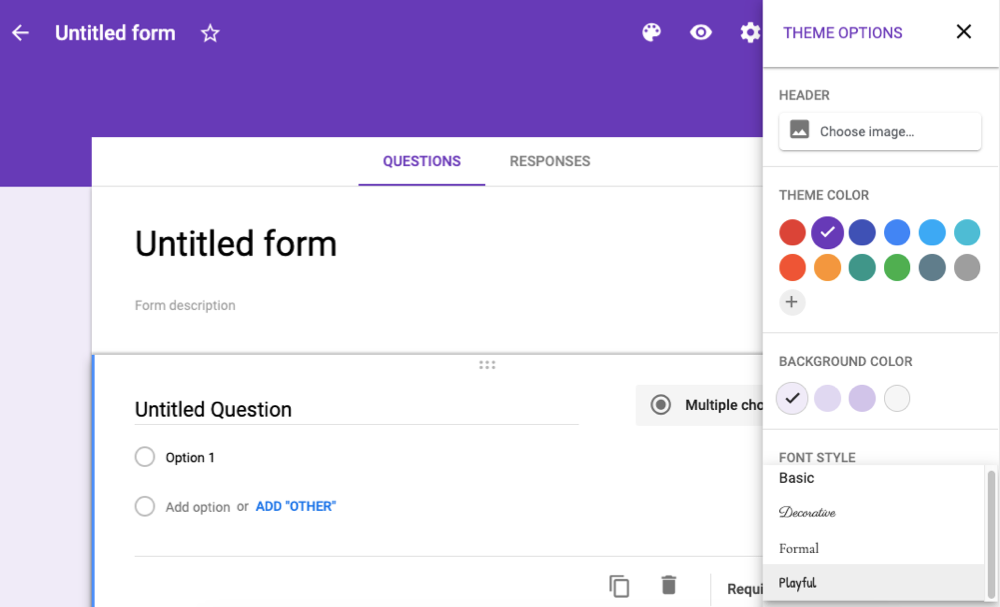
Lesser line: Google Forms doesn't give yous much wiggle room in terms of design customization.
SurveyMonkey's complimentary programme is also adequately limited when it comes to customization options: You can choose among nine pre-designed themes and adjust your survey's layout. But with a premium plan, you can upload a logo, create a custom template, choose from dozens of fonts, alter font colors and sizes, or add together a background image.
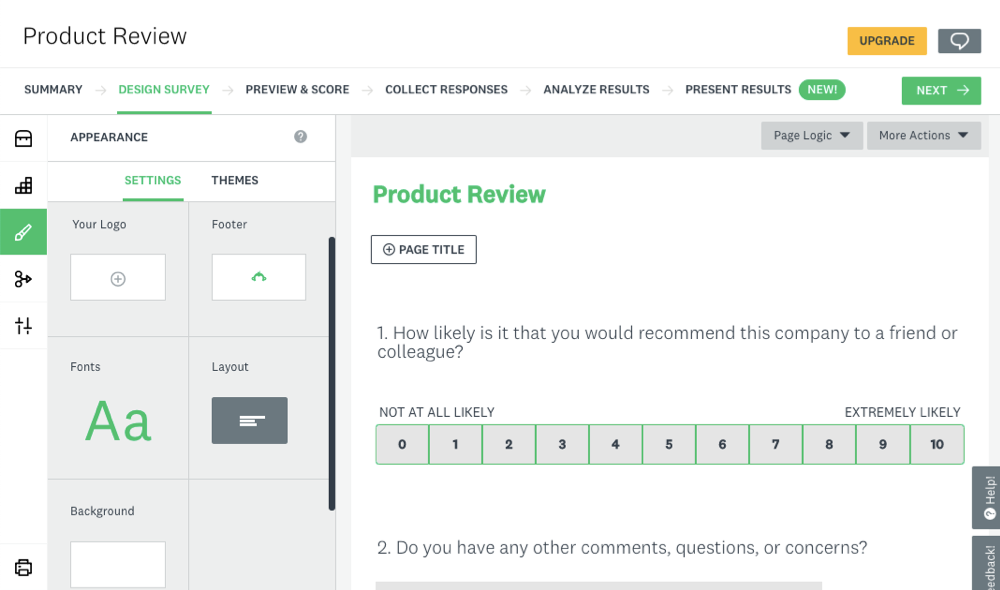
And while Google Forms always displays its branding on your surveys, the SurveyMonkey Premier individual programme ($99/calendar month) and Squad Premier plan ($75/user/calendar month) both give you the selection to remove SurveyMonkey branding.
You tin can create multi-folio surveys in both apps. But in Google Forms, multiple questions on a unmarried page display in a long listing y'all take to scroll through. In SurveyMonkey, yous can turn on an option to take questions toggle: After answering a question, the adjacent i appears automatically.
If customizing the design of your survey isn't terribly important for you, Google Forms should be sufficient. But if you demand to create a branded survey or want to customize your survey'due south design in more than particular, you lot'll want to invest in a premium SurveyMonkey plan.
Collaboration Options
SurveyMonkey offers more dynamic collaboration options than Google Forms.
Both Google Forms and SurveyMonkey allow you create custom survey templates that you tin share with your team. But beyond that, SurveyMonkey takes the block.
SurveyMonkey users who subscribe to a team plan get a number of collaboration features. You can set granular permissions to give dissimilar users the ability to view, edit, or annotate on surveys. Team members tin go out comments on both survey previews and results, and you can send notifications to team members to let them know you made a change or left a comment.
Collaboration in Google Forms is less flexible. You tin can add collaborators, but the only permission yous can ready is Edit. At that place's no view-only option, and information technology doesn't support comments. Information technology also doesn't send notifications when changes are made, and dissimilar some of Google's other tools like Docs and Sheets, Google Forms doesn't keep a history of changes that you tin review.
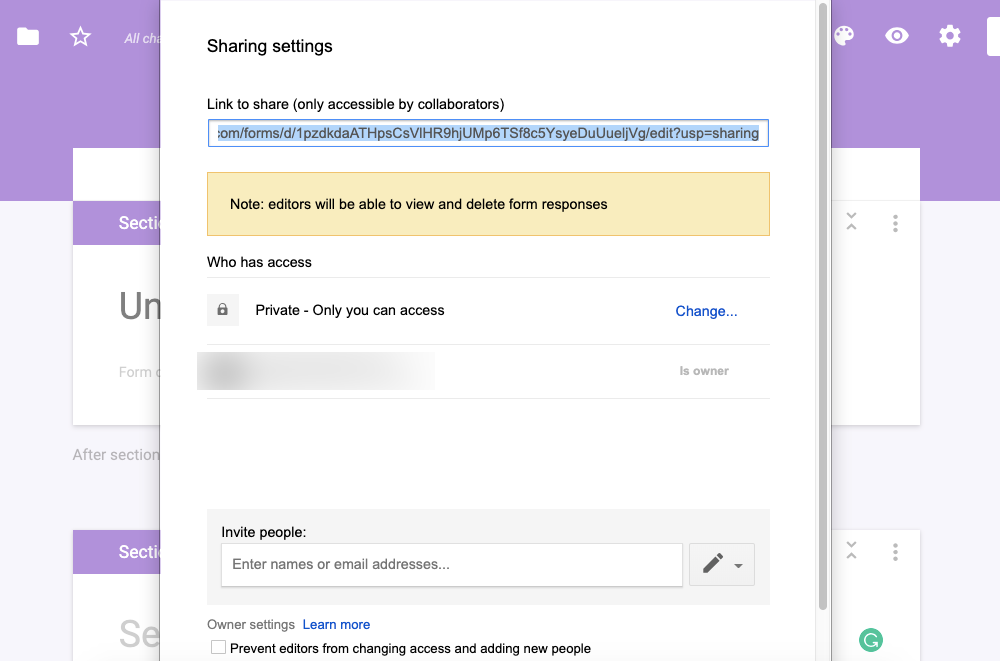
If you're collaborating with a small team, Google Forms' collaboration tools are probably all you need. But if you're collaborating with a big team or external partners—or if y'all have complex review and approving workflows—SurveyMonkey'south team program is a better choice.
Question Types, Rules, and Scoring
Google Forms has more than rules available and offers more robust automated scoring.
SurveyMonkey offers more options than Google Forms when information technology comes to question types. In addition to the bones question types you lot'll find in both tools—multiple choice, short answer, dropdowns, and checkboxes—SurveyMonkey offers sliders, payment-acceptance fields (via Stripe), and dropdown matrices.
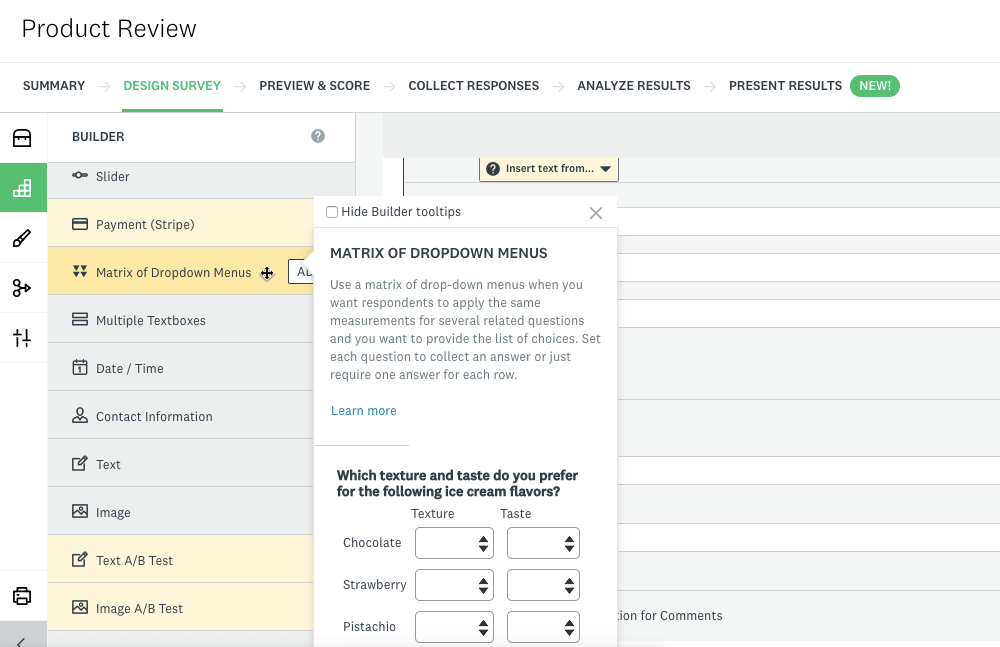
Of course, most of SurveyMonkey's more advanced question types, including file uploads—which are available for gratis in Google Forms—are simply available with a premium plan.
Both tools likewise have options for randomizing the order in which respondents see questions, which is helpful when using the tools to build quizzes. Just Google Forms simply offers an overall randomization option. SurveyMonkey provides more than granular randomization options, letting yous randomize but a specific page or certain questions. Once again, this feature is merely available with premium plans.
Google Forms lets you lot set upwardly more than specific validation rules for answers (i.east., requiring users to answer in a specific way) based on number, text, length, or regular expression. Answers that exercise non meet your rules will display customizable fault letters. This is useful for things like validating that an inputted email accost is actually formatted like an electronic mail address, ensuring cleaner information.
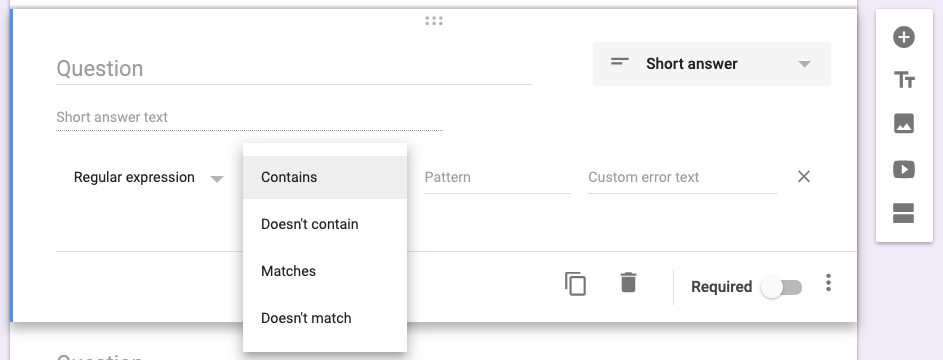
SurveyMonkey's validation rules don't allow for regular expressions, so y'all're limited to checking for date formatting, accurate email address formatting, and number formatting (east.g., allowing or disallowing the use of decimals). This is more than accessible if you lot don't know how to write regular expressions, just it limits the types of responses you can validate.
If you're using the app to create a quiz and want to provide immediate feedback, both apps offer automated scoring. Withal, Google Forms' scoring is more robust because it can be used for more than than merely multiple selection questions and dropdowns. Brusque-answer questions tin besides exist car-graded past setting a number range (eastward.g., answer should be between i and 10) or setting text rules (e.g., answer must contain the discussion "oxygen").
If you demand to collect payments through your form, SurveyMonkey offers a directly integration with Stripe that lets survey-takers brand a payment. Google Forms doesn't offer this feature, though you can include a link to a PayPal or some other payment processing tool.
Templates
SurveyMonkey offers pre-written questions and nearly 200 survey templates.
Google Forms only offers 16 bones templates that help you apace build things like task applications, society forms, and assessments.
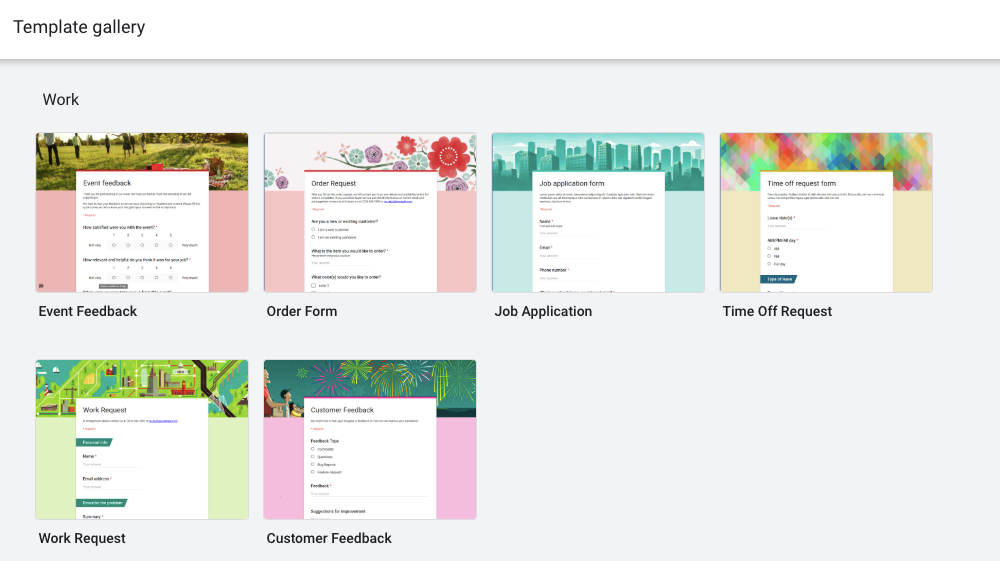
SurveyMonkey, on the other hand, offers virtually 200 survey templates—organized by industry and purpose—for everything from market inquiry surveys to employee leave interviews. These templates each incorporate questions that are vetted by SurveyMonkey's experts, and the questions are presented in an order that maximizes response quantity and quality.
Free accounts tin can access 40 short survey templates, while the full library is available to users at the Advantage level and above.
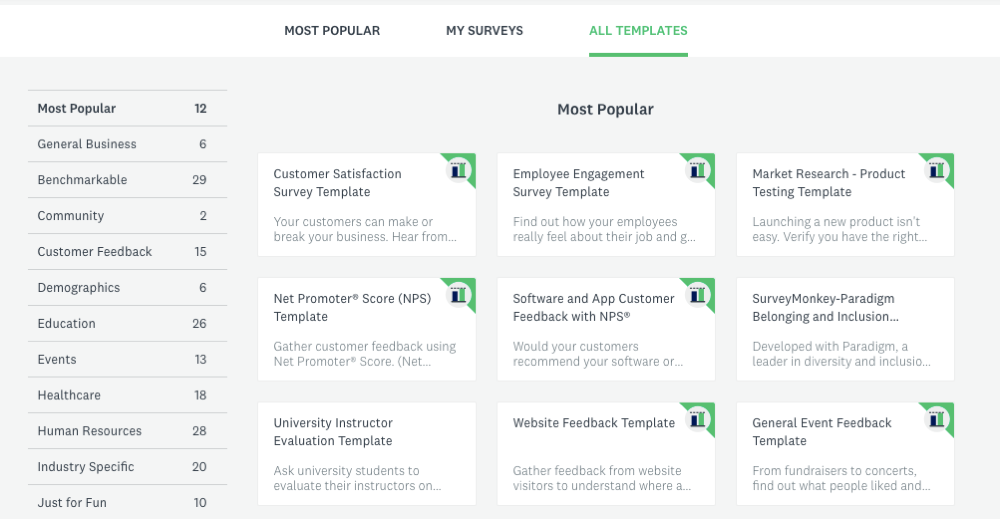
If you want to mix and match, SurveyMonkey offers all users access to a question depository financial institution of one,800+ pre-written questions. These questions have been written and reviewed by SurveyMonkey'due south survey methodologists and are certified to be methodologically sound, pregnant that the question should provide authentic results with minimal bias.
Branching and Provisional Logic
SurveyMonkey offers slightly more branching and conditional logic options.
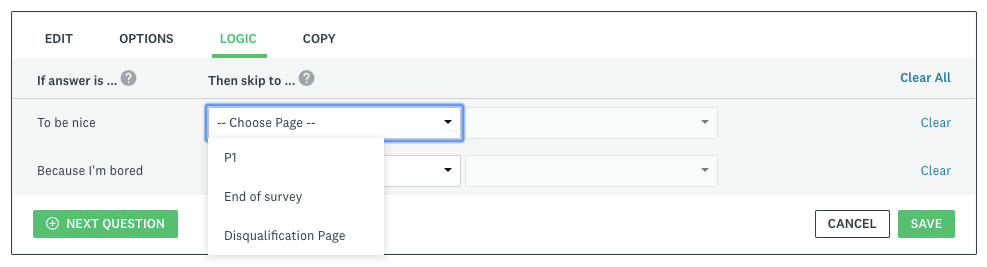
Conditional logic in surveys boils downwards to if/then statements. For example, "If the user selects Highly satisfied, then the survey ends and displays a thank-you folio." Or "If the user selects anything less than highly satisfied, ship the user to question What could we do better?"
Google Forms allows for this kind of branching for multiple choice and dropdown questions. You tin can transport users to another department or question based on their previous answer, or yous tin can choose to end the survey immediately.
SurveyMonkey likewise offers conditional logic, only just on its premium plans. It works in the same way as Google Forms: Transport a respondent to a different question, page, or the end of the survey based on how they answer a specific question. But SurveyMonkey offers conditional logic on question types that Google Forms doesn't, such as checkboxes and star ratings.
Collecting Responses
SurveyMonkey offers more means to collect survey responses.
Both Google Forms and SurveyMonkey let you send your survey via email, catch a link to post anywhere on the web, or embed the survey onto your website.
But SurveyMonkey offers a few other features that Google Forms doesn't. You can have people take your survey in Facebook Messenger, embed your survey into a mobile app, or even collect responses offline using the SurveyMonkey Anywhere app and upload them when you're back online. And if yous need some assistance getting responses to your surveys, SurveyMonkey also has a product called Audition, where yous pay them to promote your survey and then you get more responses.
Analysis and Reporting
SurveyMonkey makes information technology easy to visualize your information.
Both Google Forms and SurveyMonkey offer a diverseness of features for analyzing and visualizing your data. Both prove yous private responses equally well as summary information in graphical format.
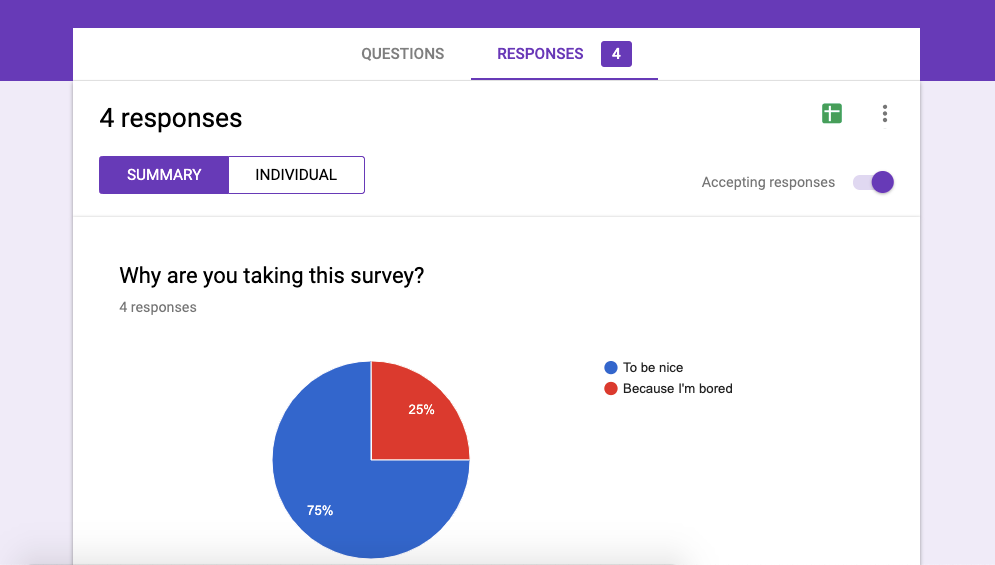
Google Forms displays different types of graphs based on what blazon of question y'all asked.
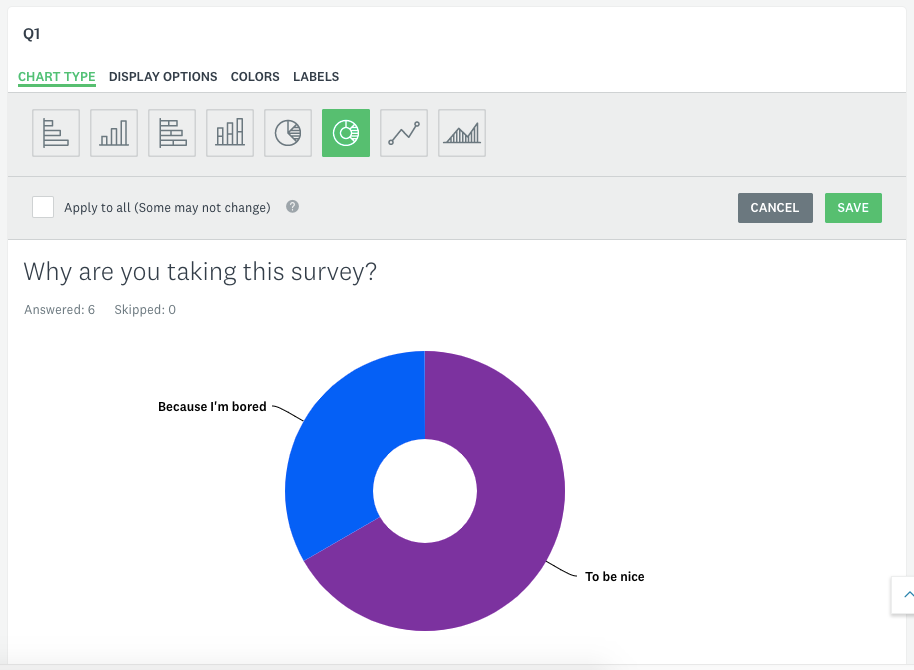
SurveyMonkey, on the other paw, lets y'all select exactly how you want your summary data to brandish. On the complimentary plan, you can cull betwixt eight graph types—including pie charts, bar graphs, and line graphs—customize the colors your graphs display in, and even change the labels shown on your graphs for the data y'all've nerveless. This makes it actually easy to visualize your data, customize information technology, catch screenshots of your graphs, and share them in a web log postal service or presentation.
Of grade, you can practice all of these things with Google Forms besides, but it'south not quite equally simple. You have to ship your data to Google Sheets and manually create your custom charts and graphs. Nonetheless, having your information in Google Sheets as well gives y'all the ability to create pivot tables and use the Explore part to analyze your information in greater particular. Or you could send your data to Google Information Studio for fifty-fifty more visualizations.
SurveyMonkey's free program doesn't let you export your results, so for deep analysis, you accept to upgrade. Its available reporting tools increase in number and capabilities at each subscription tier, giving you options to filter your responses to analyze those from a specific group, measure out sentiment, and evaluate statistical significance.
If you employ questions from SurveyMonkey's question bank, you lot can fifty-fifty benchmark responses on unremarkably-tracked metrics—like customer satisfaction—against other users' results. The data behind these benchmarks is driven by the millions of answers that SurveyMonkey collects from users, and information technology can requite you lot an idea of where you stand in the pack.
SurveyMonkey can also analyze the survey itself—fifty-fifty before yous accept whatsoever responses. The Genius characteristic scores your survey based on factors including survey length, question types, and estimated time to consummate. The score provides an overall assessment, an estimate of completion rates, and suggested areas of improvement.
Google Forms vs. SurveyMonkey: Which App Should Yous Employ?
If cost is a concern, y'all're better off going with Google Forms. While SurveyMonkey has a complimentary plan, information technology's extremely limited, and unless you're making very bones surveys and don't anticipate many responses, it won't get you far. Google Forms tin can also be a better choice for testing the waters since its more limited range of options makes it easier to set up up and distribute a survey without diving into advanced logic and analysis.
If design is a central consideration, SurveyMonkey is your improve bet. Its surveys are much more customizable, and frankly, they await more professional person than those created in Google Forms. SurveyMonkey is also a stronger option for advanced users who demand quantitative analysis for big amounts of data—or for users who feel that they can leverage options similar templates and industry benchmarks.
If you're not sure where to start, give Google Forms or SurveyMonkey's free plan a try and come across which one sticks.
Finally, here'southward an at-a-glance characteristic comparison.
| Google Forms | SurveyMonkey | |
|---|---|---|
| Pricing | 100% free | Free plan available; feature availability increases with each premium tier |
| Design and Customization | Extremely limited | Robust options with premium plans |
| Collaboration Options | Limited to multiple editors | Viewing, editing, and commenting available |
| Question Types, Rules, and Scoring | More specific answer validation options and scoring options | More than advanced question types |
| Templates | sixteen templates available | ~200 templates and ~1,800 pre-written questions |
| Branching and Conditional Logic | Available for multiple choice and dropdown questions | Available for more than question types |
| Collecting Responses | Electronic mail, link, or embed | Email, link, embed, Facebook Messenger, mobile embed, offline data collection |
| Analysis and Reporting | Express, unless y'all use it in tandem with Google Sheets or Google Data Studio | All-encompassing options for information visualization |
Automating SurveyMonkey and Google Forms
Subsequently you select your new survey tool and start collecting responses, you tin can do even more than with the data you collect using these Zaps (automated workflows by Zapier).
-
Send automatic follow-up emails to everyone who fills out your survey.
-
Automatically add survey respondents to your email marketing tool.
-
Automatically create tasks in your project management app to act on new survey responses.
Get productivity tips delivered straight to your inbox
We'll email you one-iii times per week—and never share your information.
championrusestiond.blogspot.com
Source: https://zapier.com/blog/google-forms-vs-surveymonkey/
0 Response to "How to Delete Responses and Start Survey Again on Surveymonkey"
Postar um comentário