How to Draw a Circumscribed Circle in a Triangle
It is known that the 3 vertex coordinates of a triangle are used to find the circumscribed circumvolve and the circumscribed circle of the triangle.
A triangle has a center of gravity, a middle of gravity, a centre of gravity, a center of gravity, a center of gravity, a middle of gravity, and a centre of gravity.
The outer centre, the center of an outer circle, is the intersection of iii vertical bisectors of a triangle.
Drawing an outer circle is relatively simple.
It is known that the full general formulas of the 2 linear equations are:
a1 * ten + b1 * y + c1 = 0 a2 * x + b2 * y + c2 = 0 Then, the intersection coordinates are
x = (b2 * c1 - b1 * c2) / (a2 * b1 - a1 * b2) (1) y = (a1 * c2 - a2 * c1) / (a2 * b1 - a1 * b2) (two) If it is a signal skew of ii linear equations:
(y - y1) / (x - x1) = k1 (y - y2) / (x - x2) = k2 Commencement, turn the bespeak-to-point slant into the general form. You tin can get it.
a1 = k1, b1 = -1, c1 = y1 - k1 * x1 a2 = k2, b2 = -1, c2 = y2 - k2 * x2 Substitute (1), (2) become,
x = (y2 - k2 * x2 - y1 + k1 * x1) / (k1 - k2) (three) y = (k1 * y2 - k2 * y1 - k1 * k2 * (x2 - x1)) / (k1 - k2) (4) With formulas (3) and (4), it is piece of cake to find the coordinates of the outer centre. It's easy to get the midpoint coordinates of the triangle edge. The slope of ane is also very good.
Let's fix up a triangle. The coordinates of three points are A (x1, y1), B (x2, y2), C (x3, y3).
The midpoint coordinates of edge AB are ((x1 + x2)/two, (y1 + y2)/ii), and the gradient is (y2 - y1) / (x2 - x1).
The normal of edge AB is perpendicular to AB, and the slope of the normal is (x1 - x2) / (y2 - y1)
The radius of the circumscribed circle is the distance from the center to the vertex
The center of the inner circle is the intersection point of the triangle triangle bisector. It is relatively hard to discover the inner coordinates. The cardinal is that if we find the slope of the angle bisector, we tin can use the indicate slope formula, formulas (3) and (4) to get the inner coordinates.
The slope of the angular bisector can be institute in this way. For example, to observe the slope of the angular bisector of angle A, start observe the bending between the vector (A to B) and the x-centrality, and and then notice it.
The angle betwixt the vector (A to C) and the x-axis. The sum of the two angles divided by ii is the angle between the angular bisector and the x-axis.
The radius of an inscribed circle needs to be used. The distance formula from a point to a direct line is every bit follows:
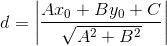
Formula clarification: The linear equation in the formula is Ax+Past+C=0, and the coordinates of point P are (x0,y0).
Lawmaking clarification:
office getAngleWithX_axis(v1, v2)
The angle between the vectors v1 to v2 and the x-axis, and the angle of return is radian.
The angle is calculated by the inverse cosine role, because the logic is the clearest and simplest when implemented by the inverse cosine function. It only needs to estimate v2.y >= v1.y.
function getMiddleSlope(a, b, c)
The gradient of the athwart bisector of the return angle cba. The return angle is radian.
function getCrossPoint(k1, v1, k2, v2)
It is known that the betoken slopes of two linear equations are obtained, and their intersection coordinates, applications of formulas (3) and (4) are obtained.
function getPointToLineDistance(p, start, end)
It is known that 2 points on a straight line commencement and end, a signal p outside the line, and the distance from the return bespeak P to the direct line.
<html> <caput> <title>Incircle and circumcircle</title> </caput> <torso> <div> <sail id="canvas" width="600" height="450" way="border: solid black 1px; cursor: default;"> </sheet> </div> <div> <input blazon="push" value="articulate" onclick="demo.clear();"> <input blazon="push button" value="generate" onclick="demo.generate(1);"> </div> <script type="text/javascript"> function getRandom (min, max) { var d = max - min; return min + Math.random() * d; } function getDistance (v1, v2) { var dx = v2.x - v1.x; var dy = v2.y - v1.y; return Math.sqrt(dx * dx + dy * dy); } role getAngleWithX_axis (v1, v2) { var distance = getDistance(v1, v2); var dx = v2.x - v1.x; var cosA = dx / distance; if (v2.y >= v1.y) { return Math.acos(cosA); } else { render 2 * Math.PI - Math.acos(cosA); } } part getMiddleSlope (a, b, c) { var a1 = getAngleWithX_axis(b, a); var a2 = getAngleWithX_axis(b, c); var a3 = (a1 + a2) / two; return Math.tan(a3); } role getCrossPoint (k1, v1, k2, v2) { var cross_x = (v2.y - k2 * v2.x - v1.y + k1 * v1.10) / (k1 - k2); var cross_y = (k1 * v2.y - k2 * v1.y - k1 * k2 * (v2.ten - v1.x)) / (k1 - k2); render new Vertex(cross_x, cross_y); } part getPointToLineDistance (p, start, terminate) { var a = end.y - start.y; var b = kickoff.x - terminate.ten; var c = end.x * beginning.y - start.x * end.y; var d = Math.abs(a * p.x + b * p.y + c) / Math.sqrt(a*a + b*b); return d; } office Demo () { var vertices = []; var circumcircleCenter; var circumcircleRadius; var incircleCenter; var incircleRadius; this.generate = function (n) { var v1 = new Vertex(getRandom(100, 200), getRandom(100, 400)); var v2 = new Vertex(getRandom(200, 400), getRandom(100, 400)); var v3 = new Vertex(getRandom(150, 350), getRandom(100, 400)); vertices.push button(v1, v2, v3); var k12 = (v2.x - v1.x) / (v1.y - v2.y); var k23 = (v3.10 - v2.10) / (v2.y - v3.y); var m12 = new Vertex((v1.10 + v2.x)/two, (v1.y + v2.y)/2); var m23 = new Vertex((v2.10 + v3.10)/ii, (v2.y + v3.y)/2); circumcircleCenter = getCrossPoint(k12, m12, k23, m23); circumcircleRadius = getDistance(circumcircleCenter, v1); var k213_m = getMiddleSlope(v2, v1, v3); var k123_m = getMiddleSlope(v1, v2, v3); incircleCenter = getCrossPoint(k213_m, v1, k123_m, v2); incircleRadius = getPointToLineDistance(incircleCenter, v1, v2); this.render(); vertices = []; }; this.clear = function () { vertices = []; this.render(); } this.render = function () { var canvas = document.getElementById('canvas'); if (!canvas.getContext) return; var context = canvas.getContext('second'); context.clearRect(0, 0, Number(canvas.width), Number(sheet.height)); if (vertices.length <= 0) { render; } vertices.forEach( function (vertex) { context.beginPath(); context.arc(vertex.x, vertex.y, 5, 0, Math.PI * 2, truthful); context.closePath(); context.fillStyle = "#0000ff"; context.fill up(); }); context.beginPath(); context.moveTo(vertices[0].10, vertices[0].y); for (var i = 1; i < vertices.length; i++) { context.lineTo(vertices[i].x, vertices[i].y); } context.lineTo(vertices[0].10, vertices[0].y); context.closePath(); context.strokeStyle = "#ff0000"; context.stroke(); drawCircle(context, circumcircleCenter, circumcircleRadius, "#006600"); drawCircle(context, incircleCenter, incircleRadius, "#990066"); } }; part drawCircle (ctx, center, radius, centerColor) { ctx.beginPath(); ctx.arc(centre.x, center.y, 5, 0, Math.PI * 2, truthful); ctx.closePath(); ctx.fillStyle = centerColor; ctx.fill up(); ctx.beginPath(); ctx.arc(center.x, center.y, radius, 0, Math.PI * 2, true); ctx.closePath(); ctx.strokeStyle = "#ff0000"; ctx.stroke(); } function Vertex (10, y) { this.x = ten; this.y = y; } var demo = new Demo(); window.onload = office () { document.getElementById("canvas").onclick = function (e) { e = eastward ? east : window.event; var rect = this.getBoundingClientRect(); demo.addAt(e.clientX - rect.left, e.clientY - rect.meridian); } }; </script> </torso> </html> championrusestiond.blogspot.com
Source: https://programmer.group/drawing-the-circumscribed-circle-and-the-circumscribed-circle-of-a-triangle.html
0 Response to "How to Draw a Circumscribed Circle in a Triangle"
Postar um comentário