When Did Tall Socks Become Cool Again
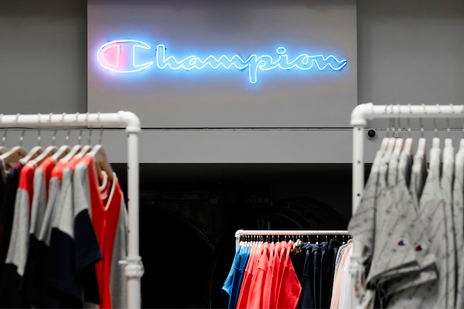
The Make That Invented the Hoodie is Finally Absurd Again
Once associated with the dadcore look of one-half-zip sweaters, chunky running shoes and baseball caps, Champion is condign absurd again.
Last month, I plant myself walking effectually the Halifax Shopping Centre with my partner when he pointed towards a hoodie from the sportswear make Champion hanging on a rack at Foot Locker, the price just south of $100. Laughing, he told me a story about how he used to fold over the tops of his white Champion logo socks to make the signature 'C' logo invisible. At his elementary school in the early 2000s, kids could be bullied on the playground for wearing the outdated athleisure brand, and he feared if people found out he was sporting the brand it would make him await "cheap" or "uncool."
Now, Champion'due south logo is stretched loud and proud beyond the back of t-shirts and sweatpants of celebrities like the Kardashians, Justin Bieber, and Rihanna; spotted alongside luxury items similar Gucci handbags and $20,000 Rolex watches. Concluding year, Risk the Rapper went then far as to claim that he helped make the brand "unlame" while broadcasting an Instagram alive stream. They just dropped a pastel-laden collection with the cult accessories make Susan Alexandra. Clearly, the 100-year-old brand is cool again.

Originally the Knickerbocker Knitting Company, Champion was a family unit business concern founded past the Feinbloom family unit of Rochester, New York in 1919. The brand started out making athletic uniforms for the University of Michigan's sports teams, the Michigan Wolverines, and word shortly spread of the make'south durability and comfort. Even during the Corking Depression, the newly named "Champion Knitting Mills" was thriving. They were the first brand to blueprint a hooded sweatshirt to shield athletes and labourers from cold weather. Past the 1940s, Champion'south appeal had expanded all the fashion to trainees in the US military machine. It wasn't until the 1960's that the 'C' logo was adopted, grabbing the attention of the National Higher Able-bodied Association, resulting in a licensing partnership with the NFL. Champion continued to pioneer styles and fabrics like breathable materials and reversible t-shirts, which trickled into hip-hop streetwear from the 1980s.
But past the early 2000s, the brand was beginning to flag. Though they were known as the brand of 27 NBA teams, Champion was often associated with the frugal "dad" wait of half-zip sweaters, mesomorphic white running shoes and baseball game caps. Their goods were ordinarily sold at section stores similar Walmart and Target, and cultural tastes were beginning to shift abroad from heritage sportswear towards brands like Lululemon and Under Armour.
That is, until around 2017, when the brand seemingly started popping up over again nearly everywhere. Champion grew 33 percent in sales in 2017, followed by xl percentage in 2018. Their parent company, Hanesbrands, expects that Champion'due south net worth will ascent to $two billion past 2022. And since 2016, their number of Instagram followers has grown from 200,000 to 6 million.
So what is behind Champion's sudden revival? Well, part of information technology is nostalgia. The resurgence of Cabbage Patch Dolls, record players and Volkswagen buses, are non all that different from Champion's. They are part of a zeitgeist: millennials associating marketing and fabric to melancholic memories. Susan Hennike, Champion's N American president told Time Magazine that the "newfound discovery" comes not only from social media, updated designs and collaborations but as well people's own memories. "Nosotros're able to capture millennials that remember wearing it in gym class. We're able to capture their parents and generations ahead of them because they have a long history with the brand," said Hennike.
Another aspect is the streetwear takeover. Champion resonates with hypebeasts who are thirsty for vintage logo sportswear. The brand collaborated with Supreme on a autobus jacket back in 2010, and since they've gone on to collaborate with streetwear-adjacent brands like Vetements and BEAMS. Young people in particular are latching onto Champion, with 9 per cent of upper-income boys and v per cent of girls identifying the make as something they'd wear, co-ordinate to a survey by Piper Jaffray.
Gen Z also recognizes the importance of sustainability; buying second-hand wearable has become a tendency in itself. Consignment and vintage shops are popping up all over, even on social media. This doesn't mean the clothes are cheaper. They are more sought after, with some more than rare pieces selling for upwards of $100 on the luxury market.
While some people might be buying a Champion hoodie at Urban Outfitters or some other overpriced shop for $90, that doesn't hateful that someone of a lower income cannot afford a Champion hoodie either. You tin can withal buy one at Walmart for $25, or if y'all sift long plenty, you lot could observe one at a thrift store for a few bucks. The loftier-low marketing technique might be what sets Champion apart from the rest. Information technology'south difficult to think of other brands that sell at both department store and luxury shop prices, come up in styles for every gender and age, and are recognized for quality.
Then, what makes Champion effective? Is it the longevity of the brand, the present nostalgic trends, the eco-friendly motion, superstar and Instagram influence, or the marketing prowess of reaching beyond the classist markets? It could be all of the higher up. Or maybe, anybody only wants a cozy sweater.
championrusestiond.blogspot.com
Source: https://fashionmagazine.com/style/champion-is-cool-again/
0 Response to "When Did Tall Socks Become Cool Again"
Postar um comentário